RIFE EDGE AI Vision Safety & PPE Monitoring: Buying Guide
A practical guide to camera-based PPE checks, hazard-zone monitoring, local video analytics and factory deployment planning.
From passive CCTV to actionable safety events
EDGE AI vision can analyse suitable camera feeds near the site and flag configured events—such as missing helmets or high-visibility vests, restricted-zone entry and line crossing. It supports safety teams by focusing attention on potential exceptions; it does not replace trained supervision, permits, guarding or other mandatory controls.
Approved cameras cover defined risk zones.
Configured models examine video locally.
Potential events reach the responsible team.
Staff verify, respond and improve rules.
Relevant RIFE solutions
These live RIFE pages are the closest match for plant-wide edge analytics and factory-specific PPE, zone and operational monitoring.
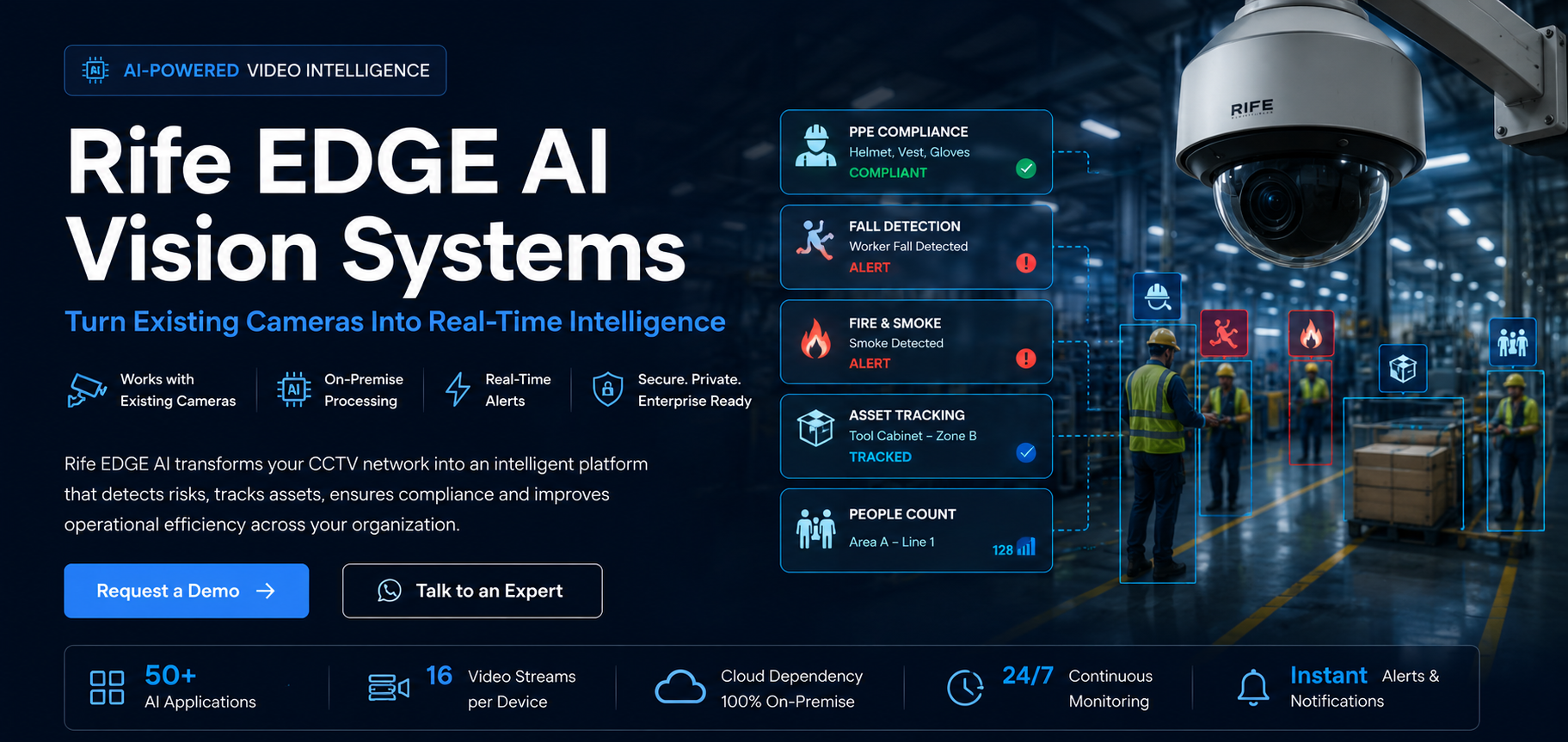
RIFE EDGE AI Vision Systems
The core platform for adding configurable safety, security and operational analytics to compatible video sources.
Explore EDGE AI Vision
AI Vision for Manufacturing
The factory-focused solution family covering PPE checks, unsafe zones, forklift-related events, tools and production visibility.
View Manufacturing AIExisting-camera reuse requires validation
Many IP cameras can provide standard network video streams, but compatibility is not automatic. During the survey, confirm protocol and codec, resolution, frame rate, lighting, viewing angle, network capacity, camera access and cybersecurity requirements. Some locations may need repositioning, improved lighting or a different camera to achieve useful detection performance.
What to specify before requesting a quote
Use cases
List the exact PPE items, zones, movements and event rules required at each location.
Camera estate
Document models, streams, viewpoints, lighting and simultaneous feeds to be analysed.
Response workflow
Define who receives alerts, expected response, escalation and evidence retention.
Processing
Size local hardware against feed count, resolution, selected models and performance targets.
Integration
Confirm dashboard, email, messaging, VMS, access-control or automation requirements.
Governance
Agree privacy notices, access roles, retention, cybersecurity and authorised use.
Evaluate the deployment approach
| Approach | Best for | Key consideration |
|---|---|---|
| Existing cameras + edge appliance | Sites with usable IP coverage and accessible streams | Validate image quality, protocol, network and permissions |
| Targeted new cameras + edge appliance | High-risk zones lacking reliable views | Design placement and lighting around the detection task |
| Pilot then scale | Most factories and multi-site programmes | Measure real conditions before final hardware and workflow rollout |
Pilot acceptance checklist
- Select one or two clearly defined risk zones and representative shifts.
- Agree what counts as a true event, false alert and missed event.
- Test day/night lighting, occlusion, PPE colours and realistic worker movement.
- Measure alert usefulness and response time—not only model detection.
- Confirm offline behaviour, storage, access control and network security.
- Document tuning, ownership, training and maintenance before scaling.
Frequently asked questions
Can existing CCTV cameras be used for helmet and vest monitoring?
Often, compatible IP camera feeds can be analysed by local edge hardware. A site survey and pilot should verify streams, viewpoints, lighting, resolution, network access and detection quality before rollout.
Does edge processing keep video on site?
On-premise processing can reduce dependence on cloud video transfer. The final data path, storage, remote access and retention policy should be documented for the chosen configuration.
Which safety events can be monitored?
Potential applications include configured PPE checks, restricted-zone intrusion, line crossing, people or vehicle movement and other approved models. Availability and suitability depend on the project scope.
Will every alert be correct?
No vision system is perfect. Camera position, lighting, occlusion, environment and model tuning affect results. Human verification and a measured pilot remain essential.
How should a factory start?
Begin with a site survey and one focused pilot, define measurable acceptance criteria, tune the workflow, train users and then expand to additional zones.
Plan an EDGE AI safety pilot
Share your camera list, site layout, priority PPE and safety events, network constraints and alert workflow with RIFE.
Request a Technical Demo