Beyond the Screen: The 2025 Guide to the Best Telepresence Robots, Prices, and Mobile Manipulators
The era of "Skype on a stick" is officially behind us. As we move deeper into 2025, robotic telepresence has evolved from a novelty into a critical tool for global business, healthcare, and education. We are no longer just looking through a camera; we are inhabiting physical spaces, navigating autonomously, and—thanks to the latest breakthroughs—interacting with the world using telepresence robots with arms.
Whether you are a hospital administrator looking to support overworked nurses, a remote executive wanting a seat at the table, or a tech enthusiast curious about the latest telepresence robot price trends in the Indian market, this expert guide covers the cutting edge of remote presence technology.
The New Standard in Robotic Telepresence
Modern telepresence robots have shed their clunky past. Today’s top models utilize AI-driven navigation, mixed reality overlays, and 5G connectivity to provide a seamless experience. They don’t just roll; they understand their environment.
The "uplifting" reality is that these machines are bridging human connection gaps like never before. They are allowing specialists to treat patients in rural villages, grandparents to attend weddings across oceans, and disabled employees to actively participate in office culture.
Best Telepresence Robots (Standard Mobility)
For most users, the goal is mobility and high-quality audio-visual connection. Here are the standouts for 2025:
1. Double 3 by Double Robotics
The Double 3 remains the gold standard for office environments. It features a "mixed reality" driver's interface, which overlays virtual waypoints on the video feed. You don’t "drive" it so much as click where you want to go, and the robot handles the navigation.
-
Best For: Corporate offices and remote collaboration.
-
Key Feature: Unified Pan-Tilt-Zoom dual cameras and self-driving capabilities.
-
Estimated Price: ~₹3,80,000 INR.
2. Ohmni Robot by OhmniLabs
If you need a lightweight, portable, and affordable option, the Ohmni is the best telepresence robot for families and small businesses. Its unique "motion-enabled" neck provides a natural nodding and looking experience, making conversations feel incredibly real.
-
Best For: Home use, elderly care, and schools.
-
Key Feature: No setup required (works out of the box) and folds for transport.
-
Estimated Price: ~₹2,30,000 – ₹2,55,000 INR.
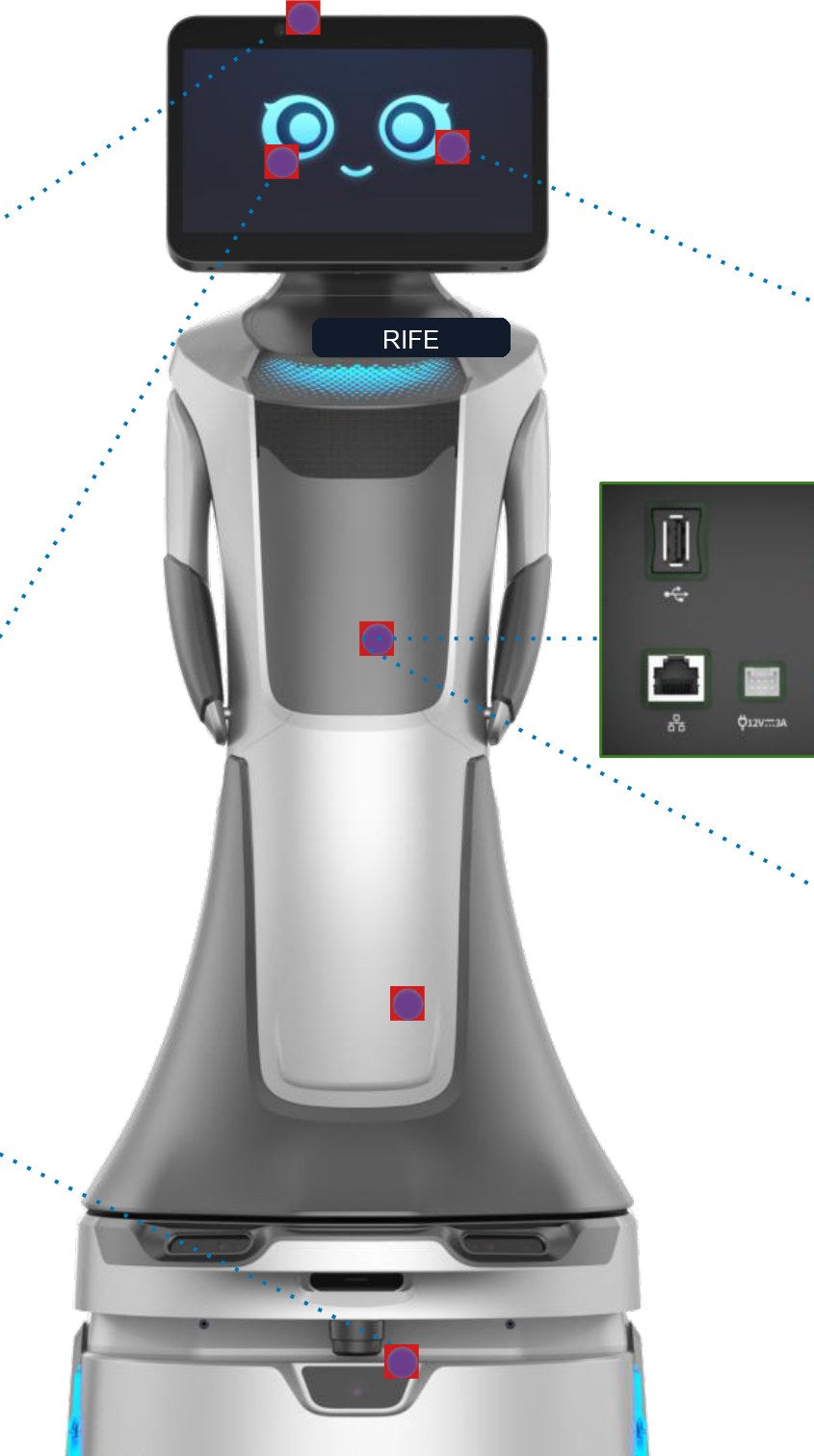
3. RIFE Nova Personal Robot
RIFE Nova is often described as a personal assistant on wheels. It focuses heavily on AI, following you around the house or office autonomously while facilitating video calls, playing music, or acting as a security patroller.
-
Best For: Smart home integration and retail hospitality.
-
Key Feature: Intelligent "follow mode" and rich app ecosystem.
-
Estimated Price: ~₹3,40,000 INR.
The Next Frontier: Telepresence Robots with Arms
This is where the technology becomes truly revolutionary. A telepresence robot with arms transforms a user from a passive observer into an active participant. These robots can press elevator buttons, open doors, pick up lab samples, or high-five a colleague.
Hello Robot’s Stretch 3
The Stretch 3 by Hello Robot is a game-changer for the mobile telepresence robot market. Unlike massive industrial bots, Stretch is slender, lightweight, and designed for human spaces. It features a telescoping arm that can reach out to grab objects, open drawers, or offer a drink.
-
Why it’s a breakthrough: It brings mobile manipulation down from a multi-crore investment to a price point accessible for researchers and innovators. It allows a remote operator to physically interact with the environment via a web interface.
-
Use Case: Assistive technology for homes and remote lab work.
Diligent Robotics’ Moxi
While Moxi is more of an autonomous teammate than a direct avatar, it represents the peak of robotic telepresence in healthcare. Moxi has a mobile base and a manipulator arm designed to fetch supplies, deliver samples, and take the load off nurses.
-
Why it Matters: It creates an uplifting support system for hospital staff, reducing burnout by handling the "fetching and gathering" tasks so nurses can focus on patient care.
Reachy by Pollen Robotics
For those looking for a human-like connection, Reachy is an open-source, bio-inspired robot with expressive antennas and two arms. It is often used in research to test advanced teleoperation where the user "feels" the robot's movements.
-
Expert Note: Reachy’s dual-arm setup allows for complex tasks that require coordination, mimicking human gestures in a way simple grippers cannot.
Telepresence Robot Price Guide: What to Expect
When searching for telepresence robot price information, it helps to categorize the market into three tiers. Note that Indian pricing often fluctuates based on import duties and taxes.
-
Consumer & Small Business (₹40,000 - ₹2,50,000 INR):
-
Entry-level devices like the Kubi (a stationary robotic neck for tablets) or the basic Ohmni.
-
Great for basic "drop-in" visits.
-
-
Professional & Enterprise (₹2,50,000 - ₹8,50,000 INR):
-
This is the sweet spot for the Double 3 and RIFE Nova.
-
Expect autonomous navigation, high-definition zoom, and robust battery life suitable for an 8-hour workday.
-
-
Advanced Research & Manipulation (₹17,00,000 - ₹65,00,000+ INR):
-
Robots like Stretch 3 or Reachy fall here.
-
The cost reflects the complex actuators, safety sensors for the arms, and advanced computing power required for remote telepresence robot manipulation.
-
Industry-Specific Use Cases
Healthcare & Eldercare
Doctors can now perform "grand rounds" from across the country. A remote telepresence robot allows a specialist to zoom in on a patient's chart or inspect a wound visually with high fidelity. For the elderly, it means family members can physically "check in," moving through the house to ensure safety rather than just calling a stationary phone.
Education & Inclusion
For students who are immunocompromised or unable to attend school, a robot offers a physical seat in the classroom. They can raise their hand (literally, with a robot arm, or virtually with lights), turn to face friends during group work, and travel between classrooms.
Manufacturing & Logistics
A mobile telepresence robot in a factory allows a manager to inspect a production line hazard-free. With the addition of arms, technical experts can remotely flip switches or guide local technicians by pointing to specific machinery parts.
The Future of Robot Telepresenc
You might see the term "robot telepresenc" (a common shorthand or typo in fast-moving tech discussions) used to describe this blending of digital and physical reality. No matter how it is spelled, the trend is clear: we are moving toward embodied internet.
We are approaching a future where distance is no longer a barrier to physical action. The combination of tactile feedback (haptics), 5G low-latency control, and smart robotic arms means that soon, you won't just be at a meeting in Tokyo while sitting in Mumbai—you will be able to shake hands, pour coffee, and truly feel present.
Conclusion
The landscape of telepresence robots in 2025 is vibrant and rapidly expanding. Whether you need a simple video avatar to keep your team connected or a sophisticated telepresence robot with arms to perform tasks remotely, the technology is ready.
Investing in this technology isn't just about buying a gadget; it's about investing in human connection. It’s about reclaiming time, reducing carbon footprints from travel, and empowering people to be where they are needed most, instantly. The best telepresence robot for you is the one that makes distance disappear—and today, that possibility is more real (and affordable) than ever.
Frequently Asked Questions
1. What is the typical telepresence robot price range in 2025?
Prices vary widely based on functionality. High-quality consumer units for families start around $2,000, while professional office robots like the Double 3 range from $4,000 to $5,000. Advanced telepresence robots with arms designed for manipulation and research can range from $20,000 to over $75,000, reflecting their complex actuators and sensors.
2. How does a telepresence robot with arms differ from a standard one?
Standard robots act as mobile webcams for audio-visual communication. A telepresence robot with arms, such as Hello Robot's Stretch, elevates this by allowing you to physically interact with the environment—opening latches, pressing buttons, or handing over objects—providing a truly embodied internet experience.
3. Is it difficult to drive a mobile telepresence robot remotely?
Not at all. Modern devices utilize advanced "assisted driving" and Mixed Reality interfaces. Instead of manually steering every inch, you often just click a destination on your screen, and the robot intelligently navigates around obstacles to get there, making robotic telepresence accessible to everyone.
4. What makes the best telepresence robot for a corporate office?
The best office robots prioritize autonomy, battery life, and self-docking capabilities. Look for features like "click-to-drive" navigation and height adjustability (standing vs. sitting modes) to ensure natural, eye-level interactions with on-site colleagues, fostering a more inclusive workplace culture.
5. Can a remote telepresence robot operate on standard Wi-Fi?
Yes, most robots are designed to switch seamlessly between Wi-Fi access points as they move through a building (roaming). Many newer models also support 4G/LTE or 5G connectivity, ensuring that your remote telepresence robot stays connected and responsive even in large warehouses or areas where Wi-Fi signals might be weak.